1940 Jefferson Nickel Value: What Is It Worth in 2026?
Common date: worn examples are worth about five cents. Keep it, or set it aside until you have a roll of old nickels to sell in one lot.
Value by condition
| Good (G-4, heavily worn) | $0.12 |
| Very Good (VG-8) | $0.18 |
| Fine (F-12) | $0.24 |
| Very Fine (VF-20) | $0.30 |
| Extremely Fine (XF-40) | $0.61 |
| About Uncirculated (AU-50) | $0.93 |
| Mint State (MS-63, uncirculated) | $19 |
A common pre-war issue with a large mintage. Worn examples trade close to face value; the premium starts at Extremely Fine.
What a 1940 Jefferson nickel looks like
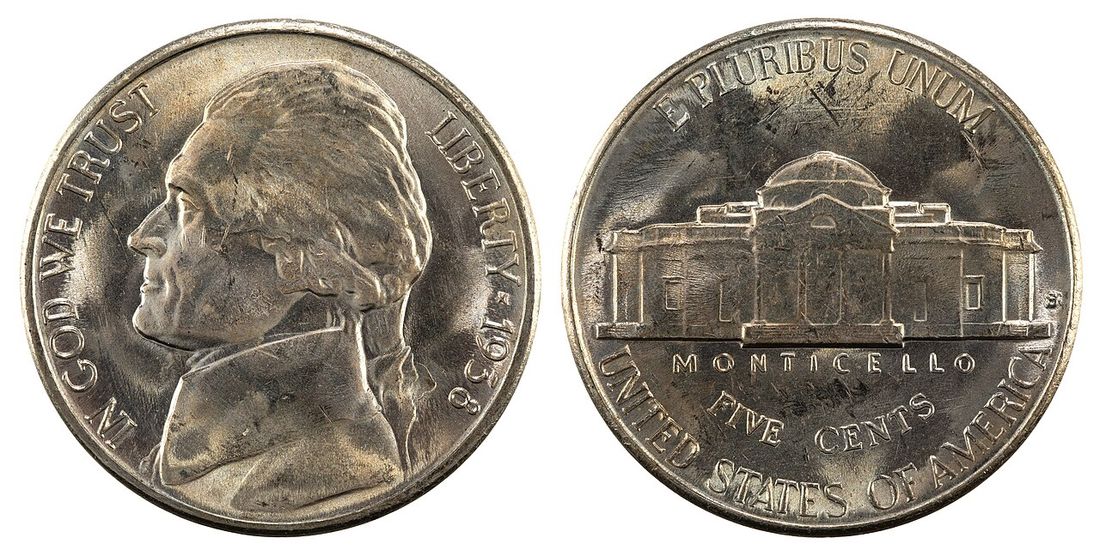
Your 1940 looks exactly like this, with "1940" where the date sits in the photo, and no letter on the back.
1940 nickel no mint mark value
If your 1940 nickel has no letter on the back, nothing is missing — it was struck at the Philadelphia Mint, which did not mark its nickels that year. Check the reverse: a Denver coin has a small D to the right of Monticello, a San Francisco coin a small S. No letter at all means Philadelphia, and "no mint mark" and "P" are the same coin, so the price table above is exactly the one to use.
In worn condition that puts your coin around $0.12, rising to $19 in uncirculated mint state. The 1940-D and 1940-S versions (with a letter on the back) are different coins — check the related links below if yours has one.
How to judge the condition of your nickel
Check Jefferson's cheekbone and hair first. These are the highest points on the front and the first places wear shows. A flat cheek with no detail separation means a lower grade; sharp hair strands with no flat spots push the coin toward Extremely Fine or better.
Then flip to Monticello's steps. The steps at the base of the building are the make-or-break detail on the back. If the coin is uncirculated and the steps are fully separated — what grading services call Full Steps (FS) — a common-date nickel can be worth several times the numbers in the table above. A 1940 with Full Steps in mint state often sells for 3–10× the regular MS price, because most strikes never brought the steps up cleanly.
When in doubt, grade down. Sellers systematically overgrade; use the lower row of the price table and you will not be disappointed.
How to confirm it's genuine
- The mint mark is on the reverse, to the right of Monticello — a small D or S. No letter means Philadelphia. A magnifier with light at a 45° angle works best.
- Never clean the coin: cleaning destroys the original surface and can cut the value in half.
- For any coin worth more than $200, PCGS/NGC grading fees (~$20–50) are money well spent.
Where to sell this coin
- eBay works best in the $1.00–$200 range. Take clear photos of both sides in natural light, and put the year, mint mark, and approximate grade in the title.
- A local coin dealer is the fastest way to cash out, but expect 60–70% of guide prices. Best for selling common dates in bulk.
- Graded high-value coins do best at auction houses like Heritage Auctions or Stack's Bowers, where realized prices are public.